Wonderland does not fall apart after time is changed. It stays standing, breathing softly, pretending nothing happened. The streets remain bright, the towers remain twisted, and the laughter still echoes through every square. Yet something inside the land has opened its eyes. This is not destruction. This is awareness.
Red feels it before anyone else does. She walks through the garden where roses never die, and for the first time, one of them bleeds. The color is deeper than red, darker than memory, and it stains her fingers like a quiet accusation. Wonderland remembers what she did, even if the people do not. Time may have moved forward, but consequence has learned how to wait.
She was raised by the Queen of Hearts, a woman who ruled through fear and clarity. Cruelty was direct in that world, sharp and undeniable. Now Red lives in a kingdom that smiles too easily and forgives too quickly. That false warmth unsettles her more than anger ever did. At least fear never lied about what it wanted.
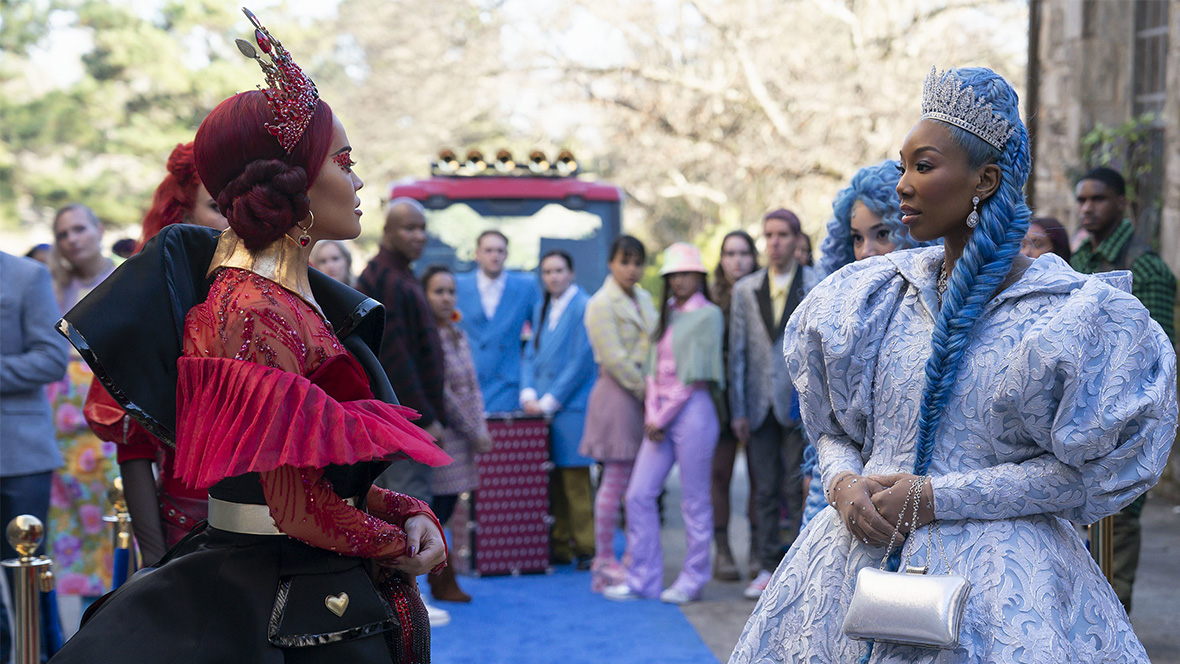
The film frames Red in constant motion, rarely allowing her to rest. She moves through crowds but never fully joins them. Faces pass her like reflections in broken mirrors, familiar yet slightly wrong. Every step she takes feels borrowed from a version of herself that no longer exists. Wonderland has accepted her, but it has not absolved her.
The Kingdom Cup Games arrive as spectacle, bright and loud, a celebration designed to distract. Music fills the air, banners ripple like waves, and competition promises unity through tradition. Yet beneath the surface, small fractures begin to show. Moments repeat with tiny errors, laughter arrives before the joke, and shadows stretch in directions they should not. Wonderland is rehearsing something it does not yet understand.
Red notices every flaw. She always has. Her gift has never been power, but attention. She feels the pull of time misaligned, like a song played half a beat too late. At night, voices follow her through empty halls, not ghosts but echoes. They speak in her voice, asking questions she refuses to answer.
“What did you change?”
“What did you save?”
“What did you lose?”
Chloe Charming arrives as balance, or at least the idea of it. She carries herself with certainty shaped by stories that end well. Her world taught her that goodness, when practiced correctly, protects itself. The camera reinforces this belief, placing her in clean frames, symmetrical spaces, and steady light. She is order personified.
Red and Chloe together create tension the film never resolves easily. They are not enemies, but they are no longer mirrors. Chloe trusts rules because rules once kept her safe. Red distrusts them because rules are what she broke to save everything. Their conversations are careful, restrained, heavy with words they choose not to speak.
Wonderland reacts to their imbalance. Streets change layout overnight, familiar paths loop unexpectedly, and the Mad Hatter’s district shifts its borders like a living maze. The land responds not with anger, but with adjustment. It is adapting to instability the way a body adapts to pain. This is not punishment. It is survival.
The antagonist enters quietly, almost unnoticed. He does not announce his presence or demand attention. He studies the fractures in time like an artist studies light. While others react to chaos, he listens to its rhythm. He understands that broken systems leave behind patterns, and patterns can be used.
He does not want to rule Wonderland. He wants to refine it. His belief is simple and dangerous: instability is wasted if it is not controlled. Where Red feels guilt for altering time, he feels opportunity. The film frames him at a distance, watching rather than acting, reminding us that true power rarely rushes.
His conversations with Red are unsettling because they lack hostility. He does not accuse her of wrongdoing. He thanks her. Without her choice, his future would not exist. This forces Red to confront a truth she avoids: saving the world does not mean you control what it becomes.
As the Games progress, reality bends further. Victories repeat, losses reverse, and fairness becomes a suggestion rather than a rule. Chloe struggles as logic fails her. She believes that if order collapses, it will be because she failed to protect it. Responsibility weighs on her heavier than fear ever could.
Red, meanwhile, begins to understand that guilt can become a form of selfishness. By focusing only on what she broke, she risks ignoring what still needs protecting. Wonderland does not ask for regret. It asks for honesty. This realization changes how she moves, how she listens, how she chooses silence over action.
The climax arrives without spectacle. There is no grand battle, no explosive reversal. Instead, Red is offered correction. She can reset the timeline, erase the fracture, and restore the illusion of perfection. The cost is simple and devastating. She will no longer exist as she is now.
The camera holds on her face, refusing escape. The noise fades, the colors soften, and the world waits. This is the film’s bravest moment. It understands that true choice is quiet. Red refuses the reset. She chooses truth over comfort, consequence over control.
Wonderland exhales. Not in relief, but in acceptance. The fractures stabilize, not healed, but acknowledged. The antagonist loses his leverage as time stops offering shortcuts. When instability becomes honest, it can no longer be harvested. He disappears without drama, undone by a world that refuses denial.
The final moments mirror the beginning. Red stands in the garden again, touching a rose. It does not bleed this time, but it is no longer perfect. A petal falls naturally, aging as it should. Wonderland remains strange, bright, and unpredictable. It is not fixed. It is alive.
Red walks away from the throne, not as a queen or a rebel, but as someone who understands that power always leaves marks. The land does not watch her anymore. It walks with her. And for the first time, Wonderland feels less like a dream and more like a place worth living in.